
Audio Mixing That Makes a Song Hold Together
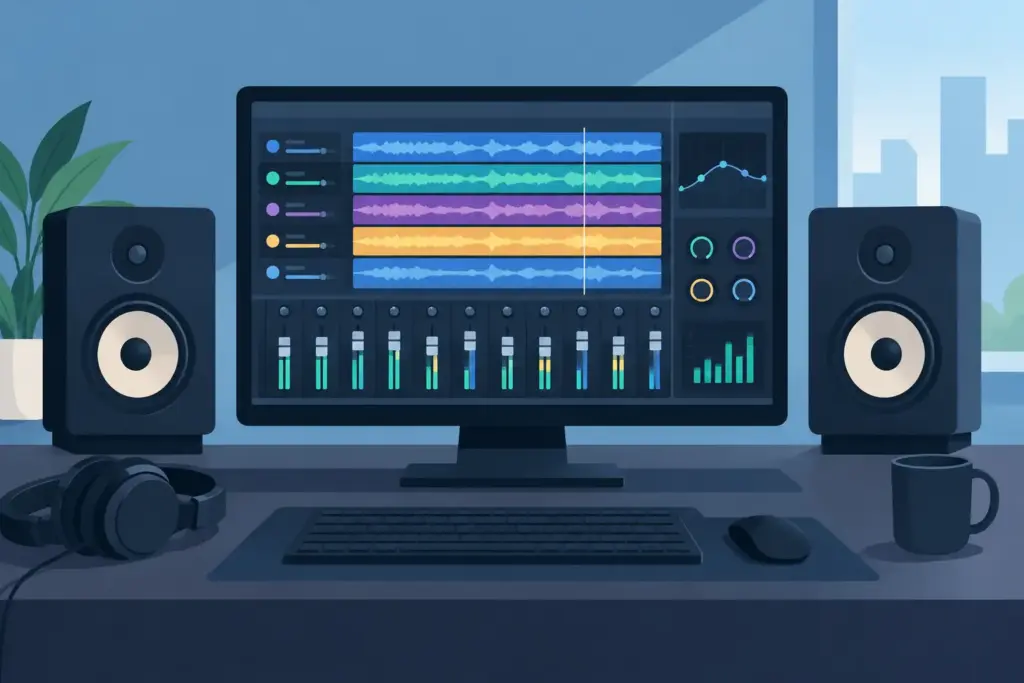
A song can have a strong chorus, a great vocal, and players who nailed their parts, yet still feel smaller than it should. That is usually not a performance problem. It is an audio mixing problem: the work of deciding what the listener hears first, what supports it, and how every part earns its place.
A finished mix should not call attention to the process. It should make the song feel inevitable. The vocal lands where it needs to land. The kick and bass work together instead of fighting for the same few inches of speaker. Guitars carry their weight without covering the lyric. Whether the listener is on good studio monitors, a truck stereo, earbuds, or a phone, the record still makes its point.
What Audio Mixing Actually Changes
Mixing is where a collection of individual tracks becomes a performance with a point of view. Level, panning, EQ, compression, effects, editing, automation, and tone all matter. More importantly, they have to serve the same song.
A country ballad may need the lead vocal close enough to feel conversational, with a steel guitar appearing only when the lyric leaves room. A rock track may need a snare that cuts through dense guitars without becoming sharp or tiring. Pop can demand a vocal that stays present through a changing arrangement, while Americana often benefits from letting a little room, pick noise, and human movement remain.
There is no universal setting for any of this. A bright acoustic guitar can be the thing that brings a chorus to life in one song and the thing that makes another song feel thin. Compression can add excitement and consistency, but too much of it can flatten the movement a player worked hard to create. Good decisions come from listening to the arrangement, the lyric, and the emotional center of the performance.
That is why a mix is more than a preset chain or an automated online result. Tools are useful. Judgment is what decides whether the chorus gets bigger at the right moment, whether the vocal needs to pull back for one line, or whether a guitar part should be featured, softened, or removed entirely.
Start With Tracks That Can Be Mixed
The best mix cannot perfectly replace a missing performance, a distorted vocal recorded too hot, or a guitar part that is out of tune with the rest of the arrangement. It can be improved a lot (often enough), and good mixers work with artists and producers to get it done.
Before sending multitracks, listen through the song from the beginning. Confirm that all tracks begin at the same point, even if some are silent for several bars. Print any creative sounds (particularly virtual instruments) that are essential to the identity of the track. If a particular delay throw, guitar effect, keyboard patch, or vocal treatment is part of the song, say so clearly and send both the bare and processed tracks to the mix engineer.
It also helps to provide a rough reference mix. Not because the final result should copy it exactly, but because it reveals intent. If the rough has a deliberately dry vocal, a loud tambourine, or a quiet first verse that opens into a large chorus, that information keeps the conversation focused on the music rather than guesswork.
References from other artists can help as well, with one caution. A reference tells an engineer about direction, not a recipe. Your recording has its own players, room, microphones, arrangement, and limitations. Asking a lean three-piece rock track to sound exactly like a heavily layered major-label production can lead to bad choices. The better question is usually, “What do you respond to in this reference?” It may be the vocal intimacy, the drum punch, the width, or the amount of low end.
The Decisions That Make a Mix Feel Like a Record
The first job is establishing priority. In most song-driven music, the lead vocal and lyric need a clear path to the listener. That does not mean the vocal is always the loudest thing in the mix. It means the listener can follow it without strain, even when the band opens up.
From there, the rhythm section has to agree on a foundation. A kick drum and bass guitar often occupy similar territory, but they do not need to sound identical or compete at the same frequency. One can provide the initial punch while the other provides the sustained note. Small EQ and level choices, along with the way compression reacts, can make that relationship feel solid. This is what good mix engineers do.
Guitars, keys, background vocals, percussion, and room mics create the frame around that foundation. Panning gives them physical space. EQ gives them tonal space. Arrangement awareness gives them musical space. Often the most effective move is not adding more color. It is clearing a narrow opening so the important part can speak.
Automation is where a static balance becomes a performance. A vocal may need a word lifted at the end of a line. A guitar hook may deserve to rise between phrases and tuck back under the next verse. Reverb can widen a chorus, then shorten when the song needs to feel close again. Those moves are subtle when they work, but listeners feel them.
Why Translation Matters More Than One Perfect Playback
A mix that impresses on one pair of speakers can still fail in the places people actually hear music. Deep bass may disappear on a phone. A bright vocal may become harsh in earbuds. Wide guitars may lose energy when played in mono. This is not a reason to mix for the lowest common denominator. It is a reason to check the balance honestly.
Translation is partly technical and partly musical. A controlled low end keeps the song from turning muddy in a car. A present midrange lets the vocal and snare survive smaller speakers. Sensible stereo choices retain the impact of the arrangement when playback collapses toward mono. The goal is not identical sound everywhere. The goal is a song that remains recognizable, balanced, and emotionally convincing everywhere.
This is also why mixing and mastering are different stages. Mixing establishes the relationship among the tracks. Mastering prepares the finished stereo mix for release, with attention to overall level, tonal balance, sequence, and delivery files. Trying to solve a crowded vocal or an overbearing cymbal with mastering is usually too late. The individual tracks need attention in the mix. Increasingly, mix engineers are mastering their own mixes for streaming, but vinyl mastering usually needs a mastering engineer.
Analog Sessions Need a Different Kind of Care
Legacy tape sessions can be some of the most rewarding projects to mix, and some of the least forgiving. A 24-track reel from the 1970s, 1980s, or 1990s may contain a performance that cannot be recreated, but the tape itself may be aging. Playback machine alignment, tape condition, track identification, and careful transfer come before creative decisions.
Once the tracks are safely transferred, the same musical questions still apply. What is the song trying to say? Which parts define the record? Where should the vocal live? The difference is that archival work also asks how much of the original character to preserve. Tape hiss, room sound, and slight imperfections may be part of the identity of the recording. It should be accurately transferred to digital, but removing every trace of age can leave a historically real performance sounding strangely generic.
A careful mix respects the source while making it usable now. That may mean retaining the warmth and movement of the original recording while giving the vocal, low end, and overall balance the clarity needed for current playback and streaming delivery.
A Productive Mix Conversation Saves Time
The strongest mix projects are collaborative without becoming endless. Before work begins, identify what is non-negotiable, what is flexible, and what has been bothering you about the demo. A few plainspoken notes are more useful than a long list of plugin requests.
During revisions, describe what you hear rather than trying to diagnose the technical cause. “The vocal disappears when the guitars enter” is helpful. “The chorus needs more lift” is helpful. “Make it sound expensive” is harder to act on unless you can explain what that means to you.
At TRC Studios, artists can take part in a remote mix session through Sessionwire or review a focused first pass and respond with notes. Either approach can work. Real-time participation is useful when arrangement choices are still being made. A first-pass review can be better when you need to live with the mix in your normal listening environment before responding.
The right mix does not make every track equally loud or polished. It makes the song believable. If your recording has the performance and the parts, give the mix engineer a clear picture of what matters most, then leave enough room for experienced ears to make the record speak.